
Where Dynamics 365 Field Service fits in the Microsoft ecosystem
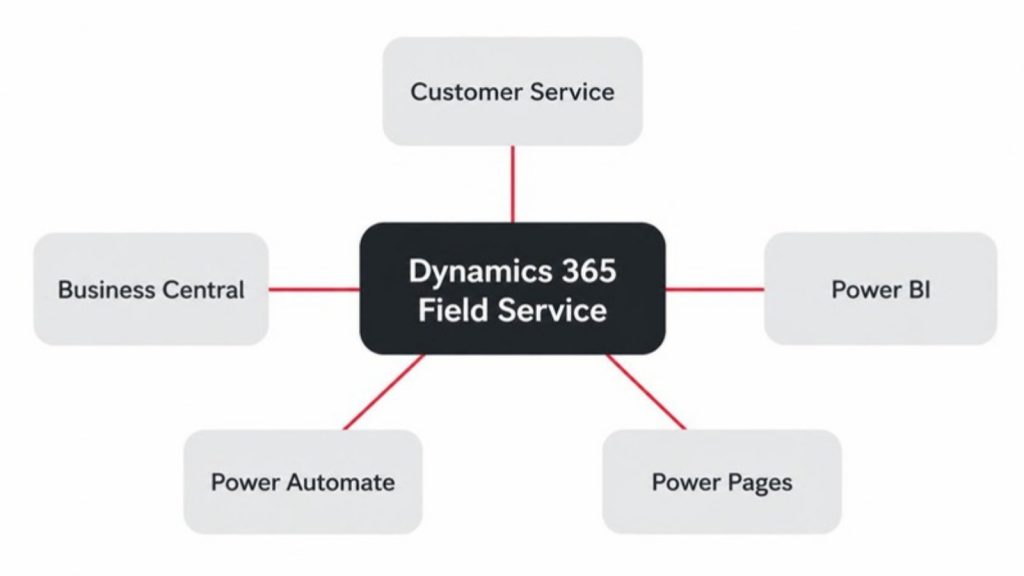
Picture a service business a few months after go-live. Work orders live in Dynamics 365 Field Service, invoices live in the finance system, and someone in the back office spends every Friday re-keying one into the other. Customer service logs calls somewhere else, so an engineer arrives on site with no idea the customer has already rung twice.
None of that is a software failure. It’s what happens when Field Service is bought as a standalone app and the connections are left for phase two.
Part of the platform, not bolted on
Field Service is a first-party Dynamics 365 app built on the Power Platform, with Dataverse as its data layer. Accounts, contacts and products are shared with the other Dynamics 365 apps, and access is governed through Microsoft Entra ID and security roles. The dispatcher’s web app and the technician’s mobile app read the same data, so a status change made on site appears on the schedule board without a phone call.
That shared foundation is the advantage, but only if you design for it. Every join you plan up front is a spreadsheet nobody has to maintain later.
The joins that matter most
Dynamics 365 Customer Service is often the front door. A case can become a work order through Microsoft’s case-to-work-order process, which carries the incident type, description and functional location across, so the engineer sees what the customer actually reported. Outlook and Teams are where people already spend their day: bookings tied to work orders can sync into a technician’s Outlook calendar, and Teams lets colleagues chat in the context of a work order. That calendar sync runs one way, so changes made in Outlook won’t come back as bookings.
Finance is the join that costs most when it’s left late. Microsoft ships its own integration between Field Service and Dynamics 365 Business Central, which keeps products, resources and warehouses in step and passes completed work across for invoicing. If you run Dynamics 365 Finance and Supply Chain Management, check the current route carefully, because Microsoft is moving the financial integration to Dynamics 365 Project Operations and new environments can no longer install the older direct integration.
Then there’s the rest of the Power Platform. Power Automate reacts to events in Dataverse, Power BI can show how many jobs you complete and how much time goes on travel, and Power Pages can let customers log a fault and follow it without phoning in. Our Perth Panthers Power Platform blog shows how these pieces fit together for a sports venue.
Decide the joins before you build
Most integration pain starts as a data problem that surfaces somewhere else. If a product or price list is wrong in Field Service, the finance system doesn’t correct it; it simply posts the wrong figure. So settle these questions in discovery, before anyone configures a form:
- Where do requests come from, and how does each become a work order?
- Which system owns customers, products and prices?
- How does completed work become an invoice, and when does parts usage post?
- What do technicians need to see in Outlook and Teams?
- What will managers report on, and what can customers see?
- Who can see and change what?
Write the answers down as a simple map of systems and data flows, and agree an owner for each one. That map becomes the brief for every integration, report and portal that follows.
How Proximo 3 helps
We map those joins in discovery, before build starts, and design Field Service and the systems around it as one operation. Every project runs on development, test and production environments with the current release, so integrations are proven before they touch live data. Because we also deliver the Dynamics 365 and Power Platform work that sits around Field Service, the portal, the reports, the automation and the finance integration are designed by the same team that designs the work order.
Want to know what it costs before you commit? Our online quote calculator sets out licence, implementation and support costs, and the month you’d expect to break even.